Chanting Mantra and Its Benefits

Chanting typically involves repeating a mantra or a prayer.  “Man” means mind and “tra” means across, so a mantra is something that is repeatedly crossing your mind to control your thoughts for meditation.  You are giving your hyperactive mind something holy to play with so that it calms down.  You can also interpret the word to mean a phrase which allows you to cross over your mind to get to your heart.  The words of a mantra are a boat that takes you across the ocean of your mind to arrive at the shores of the divine.


Repeating these words out loud has a specific effect on the body.  As you say the mantra, your tongue is hitting meridian points on the top of the upper palate of the mouth, which affects the energies going to different glands such as the hypothalamus, the pineal, and the pituitary.  By stimulating these meridian points, you are physically producing the effect of relaxation and an altered state of consciousness.

When you first start, don’t worry about your pronunciation and don’t worry about hitting the right notes.  All of this will come with time.  Chanting involves so much repeating, that you pick things up eventually.  It can be useful to look up the words of the mantra, because sometimes the sounds are so foreign to the average westerner that your mind gets a bit confused.  Spirit Voyage has a portion of its website called Mantrapedia which allows you to do just that.  But do not become caught up in perfection as you are beginning…all sounds made to the divine are good sounds.

When a mantra is chanted in rhythmic tone with ups and downs, they create a melodious effect in the body . This effect can be defined as the Neuro-linguistic effect. The Neuro- linguistic effect will be possible even if you do not know the meaning of the mantra. Hence knowing the meaning of every mantra is not compulsory.

At the same time if you know the meaning it has got an additional effect which is known as Neuro-linguistic (NLE) + Psycholinguistic effect (PLE). Lot of Research studies have been carried out by many and important results derived by one of the famous professors Dr. T. Temple Tutler, of the Cleveland University, USA on these effects are remarkable. The NLE and PLE effects are due to the production and spreading of curative chemicals in the brain. These curative chemicals give smoothening and curing effect in the body. Thus mantra chanting is no way a superstition. It can also be directly called as music therapy or mantra therapy in modern words.

Listening to mantras directly lowers blood pressure, normalizes heart beat rate, brain wave pattern, adrenalin level, even cholesterol level. That is the reason why modern doctors advise the people under high tension to sit and listen to music or mantras for few minutes. This has become an accepted procedure just like the yoga and Pranayam practices. Even chanting the kirtans, melodious bhajans, songs, etc., have the good effect almost similar to the NLE and PLE. How ever there should a melodious pattern for that. The music/ song/mantra should never be hard/ harsh/rough/ etc. The speed also should have a smoothening effect for example even Gayatri mantra chanting should be done at the range of 4 - 8 numbers per minute, Om Namo Narayanaaya at 38 -62 and Om Namah Sivaaya at 42 - 68 range per minute.

Chanting the mantras everyday is excellent and important at a particular time. In physics the time, space and observer are the three important factors. Exactly like that the time, space and the person connected with chanting/listening mantras are three important factors for deriving benefit of mantras. Hence sareera shuddhi, aahara shuddhi, mana shuddhi, vaak shuddhi and karma shuddhi are essential for deriving the full benefit of chanting the mantra. Also the place where you are sitting should give calming effect, comfortable feeling etc. The ideal timings are the prabhata sandhya and saayam sandhya. (Morning & evening) Group chanting is excellent. Absolutely no mistake is expected in Vedic mantra chanting. When you are sick due to ill health or old age, one need not worry too much about his incapability of chanting the mantras. Mantras are chanted for solving our problems and for positive effects but mantra chanting/ not chanting should not become another problem for us. The ideal sound for mantra chanting can be maintained if possible at radius 7 meters. Veda mantras chanting is not easy so it is advised not to chant without the guidance from a guru.

Five Facebook Group With More Then One Millions Member (2013 last)

I am socked that  people are selling facebook group in their website and blog. I cant believe that any people
purchase these tiny things (i think its free but its valuable for bloggers and web promoters) by investing money. Cause anybody can search these largest facebook group without tools and trick in free.
Today i am going to Give you five millions members facebook group. And 3-4  half millions members facebook group.      Actually i am doing research on facebook group. i just make a tiny search tools which search biggest facebook group in its invironments. If it dig more larger facebook group i will update in my

blog. I saw many website selling such a so called group . But i am  going give it free. Its real. and promise . just click in my blog link and join this biggest facebook group and promote your business page or  personal page.


                                           At last i have a small request to all, please

subscribe my channel. join my facebook group, and Follow me on

 google+ thanks.

   http://kishorkc.blogspot.com      https://www.facebook.com/groups/manakamana28/
  http://www.youtube.com/kishorkc28


Here are the five facebook groups which has more then Five millions members.

https://www.facebook.com/groups/dil.funcky.people.jaly/
 https://www.facebook.com/groups/love.omy/
https://www.facebook.com/groups/nationalmedline
 https://www.facebook.com/groups/manakamana28/
 https://www.facebook.com/groups/mycomputerhelps/ 

Here are the five facebook groups which has more then half millions member

https://www.facebook.com/groups/hotdeathly/
 https://www.facebook.com/groups/jamshid.mardan/
https://www.facebook.com/groups/TRUCOSBLOGGER/
https://www.facebook.com/groups/209009982520044/

Don't spam these group. don't misuse these groups. Enjoy.


Vijaya Dashami Mantra and Its Meaning


                                          आयुर्द्रोणसुते श्रियो दशरथे शत्रुक्षयं राघवे।
                                                   ऐश्वर्यं नहुषे गतिश्च पवने मानञ्च दुर्योधने।।


                                               दानं सूर्यसुते बलं हलधरे सत्यञ्च कुन्तीसुते।
                                                        विज्ञानं विदुरे भवन्तु भवतां कीर्तिश्च 
नारायणे।

Ayu Drona sute, Sriyem Dasarathae, Satru Chheyam Raghabe
Aishoryei Nahushe Gatischa pawane Manancha Duryodhane
Sourya Shanta nabe, Balam Haldhare, Satyanta Kunti Sute
Bigyani Bidure Bhawati Bhabatam, Kritischha Narayane

Its meaning:
Ayu Drona sute : May you become immo
rtal like the son of Dronacharya i.e Aswasthama
Sriyem Dasarathae : May your prestige prosper like that of King Dasaratha of Ayodhya
Satru Chheyam Raghabe : May you become able to wipe out your enemies like Lord Ram.
Aishoryai Nahushe : May your material wellbeing thrive like that of King Nahush
Gatischa pawane : May your speed equate with that of the air
Manancha Duryodhane : May people respect you like they used to respect to prince Duryodhan of Hastinapur
Sourya Shanta nabe : May you become a powerful worrier like Bhismapitama of Mahabharata who was the son of Santanu
Balam Haldhare : May you become stronger like Balaram, the elder brother of Lord Krishna
Satyanta Kunti Sute : May you become truthful like Youdhisthir, the son of Kunti, who never lied
Bigyani Bidure Bhawati Bhabatam : May you become as wise as the Bidhur
Kritischha Narayane : May your glory flourish like that of Lord Bishnu

जयन्ती मङ्गला काली भद्रकाली कपालिनी ।
दुर्गा शिवा क्षमा धात्री स्वाहा स्वधा नमोऽस्तु ते ॥२॥

Jayantii Manggalaa Kaalii Bhadrakaalii Kapaalinii |
Durgaa Shivaa Kssamaa Dhaatrii Svaahaa Svadhaa Namostu Te ||2||

Meaning:
2.1: Salutations to the Ever-Victorious and Ever-Auspicious Devi Kali, Salutations to Devi Bhadrakali Who Wear a Garland of Skulls,
2.2: Salutations to Devi Durga, the Ever-Auspicious One, and One with Shiva (as His Consort), Who is the embodiment of Forbearance and Supporter of All Beings; Who is Swaha (the cosmic being to whom the individual being is surrendered) and Swadha (the cosmic being to whom the sacrificial offering goes); Salutations to You.

Happy Vijaya Dashami......


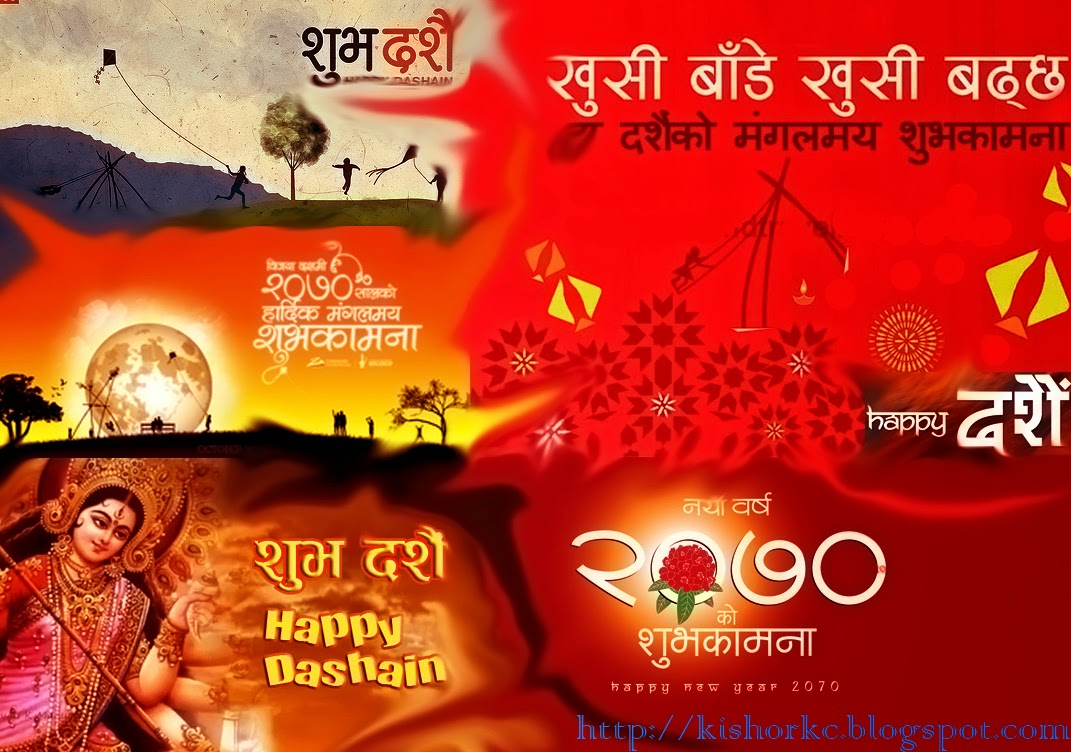
Vijaya Dashami The great festivals of Nepal

Vijaya Dashami Meaning
Vijaya Dashami also referred to as Dashain, ‘Navaratha’ or ‘Navaratri,’ (in India Dashara)  has deep-running social, religious, and cultural significance. It is called ‘Navaratha’ because it is believed to have emerged from the custom of offering puja to the chariot of the Goddess Durga who fought hectic battles for nine nights to vanquish demons, the kings of evil (literally ‘nava’ means nine and ‘ratha’ means chariot). Since the slaying of demons took place at nights, this
period is also called ‘Navaratri’. In the Sanskrit, ratri refers to the night. However, both ‘Navaratha,’ and ‘Navaratri’ belie the actual duration of the festival as it runs for a full fortnight, ending on the full moon day.
Interestingly enough, Dashain speaks of the female power represented by the goddess
Durga, whom the world invokes for overcoming the demons who are invincible to every other deity save her. People of all regions and castes celebrate this festival by reuniting with their family members. Therefore, Dashain also serves to strengthen familial and social ties in the diverse societies of Nepal.

How is dashain Celebrated

The first day of Dashain is called Ghatasthapana, which literally means pot establishing. On this day the kalash, (holy water vessel) symbolising goddess Durga often with her image embossed on the side is placed in the prayer room. The kalash is filled with holy water and covered with cowdung on to which seeds are sown. A small rectangular sand block is made and the kalash is put in the centre. The surrounding bed of sand is also seeded with grains. The ghatasthapana ritual is performed at a certain auspicious moment determined by the astrologers. At that particular moment the priest intones a welcome, requesting goddess Durga to bless the vessel with her presence. 

The room where the kalash is established is called 'Dashain Ghar'. Generally women are not allowed to enter the room where Dashain puja is being carried out. A priest or a household man worships the kalash everyday once in the morning and then in the evening. The kalash and the sand are sprinkled with holy water everyday and it is shielded from direct sunlight. By the tenth day, the seed will have grown to five or six inches long yellow grass. The sacred yellow grass is called 'Jamara'. It is bestowed by the elders atop the heads of those younger to them during the last five days when tika is put on. The jamara is taken as a token of Goddess Durga as well as the elders blessing. 

As days passes by regular rituals are observed till the seventh day. The seventh day is called 'Fulpati'. On this day the jamara to be used by the royal household is brought from their ancestral royal house in Gorkha about a hundred and sixty nine kilometres away over the hills north west of the valley of Kathmandu. A parade is held in the Hanuman Dhoka Royal Palace. The fulpati, i.e. the procession bearing the jamara and other items necessary for the tika, is brought from Gorkha after a three day walk and most of the government officials are eagerly waiting for the fulpati parade to arrive at Rani Phokari in the afternoon. Rani Phokari area is filled with hundreds of government officials meticulously attired in the traditional formal dress. 

In fulpati, the royal kalash filled with holy water, banana stalks, jamara and sugar cane tied with red cloth is carried by Brahmans from the ancestral royal house on a decorated palanquin under a gold tipped and embroidered umbrella, led by the military platoon of the royal priest. The government officials also join the fulpati parade. Whilst the fulpati parade is heading towards the old royal palace, His Majesty the King observes the ceremonies taking place in Tundikhel, the army parade ground in the center of the city. There a majestic display of the Royal Nepalese Army is held. Guns are fired and the entire valley echoes with the resonance sound of it. The firing continues for ten to fifteen minutes to honour the fulpati. By the time the function ends the royal fulpati is already taken inside the Dashain ghar in Hanuman Dhoka Palace. With this the Dashain feasting starts. 

The eighth day is called the 'Maha Asthami'. The fervour of worship and sacrifice to Durga and Kali increases. On this day many orthodox Hindus will be fasting. Sacrifices are held in almost every house through out the day. The night of the eighth day is called 'Kal Ratri', the dark night. Hundreds of goats, sheep and buffaloes are sacrificed at the mother goddess temples. In the darkness of the night Durga temples, army barracks, and old palaces all over Nepal hold sacrifices for the mother goddess. The sacrifice continues till dawn. The old palace in Basantapur Hanuman Dhoka, is active throughout the night with worships in almost every courtyard. While the puja is being carried out great feasts are held in the homes of common people where large amount of meat are consumed. 

The ninth day is called 'Nawami'. The Taleju temple at Hanuman Dhoka is opened for the public only once a year on this day. Thousands of people go and pay their respect to the goddess day. Temples of mother goddess are filled with people from dawn till dusk. On this day the official military sacrifices are held in the 'Kot' courtyard at Hanuman Dhoka. The government allows foreigners to witness this function so hundreds of tourists and diplomats eagerly gather here. Animals mostly black buffaloes are slaughtered by hundreds to honour Durga the goddess of victory and might and to seek her blessing. Military bands play war tunes, guns boom and officers with beautifully decorated medals in full uniform stand there. When the function ends the courtyard is filled ankle deep with blood. On this very day the god Vishwas Karma, the God of creativity is also worshiped. All factories, vehicles, any machinery instruments and anything from which we make a living are worshiped. We also give sacrifices to all moving machinery like cars, aeroplanes, trucks etc. to get the blessing from goddess Durga for protection for vehicles and their occupants against accidents during the year. The entire day is colourful. 

The tenth day is the 'Dashami'. On this day we take tika and jamara from our elders and receive their blessing. We visit our elders in their home and get tika from them while our younger ones come to our home to receive blessing from us. The importance of Dasain also lies in the fact that on this day family members from far off and distant relatives come for a visit as well as to receive tika from the head of the family. This function continues for four days. His Majesty also receives tika from the royal priests and then gives on tika to his loyal subjects. Thousands of loyal Nepalese people as well as foreigners also receive tika from His Majesty the King as this is said to be auspicious. After four days of rushing around and meeting your relatives Dashain ends on the full moon day, the fifteenth day. In the last day people stay at home and rest. The full moon day is also called 'Kojagrata' meaning 'who is awake'. The Hindu goddess of wealth Laxmi is worshipped. On this day the goddess Laxmi is given an invitation to visit each and everyone. 

After Dashain the nation settles back to normal. After receiving the blessing of goddess Durga, people are ready to work and acquire virtue, power and wealth. Dashain thus is not only the longest festival but also the most anticipated one among all the festivals of Nepal. 

why dashain Celebrated
 The stories behind celebration of Dashain are as follows:   
 
  Victory of Prabhu Ramchandra over Ravana (Ten Headed Devil – The King of Lanka) 

On this day in the Treta Yug, Shri Ram (7th incarnation of Vishnu), killed the great demon Ravan who had abducted Ram's wife Sita to his kingdom of Lanka. Ram, along, with his brother Lakshman follower Hanuman, and an army of monkeys fought a great battle to rescue his wife Sita. The war against Ravan lasted for ten days.

Rama had performed "Chandi Hom” and invoked the blessings of Durga to kill Ravana.  Durga blessed Rama with the secret to kill Ravana.  Ravana was defeated in his own kingdom of Lanka by Rama & the vanarsena.  Rama with Sita & Laxman returned victorious to his kingdom of Ayodhya on the Ashwin Shukla dashami.  This victory of Rama is since then celebrated as “Vijaya Dashami”. 

So also prior to the defeat of Ravana, when Rambhakt Shri Hanuman went to Lanka to search Sita, he found her on the day of Ashvin shukla dashami.

During these 10 days of Dasara, huge idols of Ravana, Kumbhakarna (brother of Ravana) & Meghanad (son of Ravana) are erected and are set on fire by the enthusiastic youth at the sun set.  

After Dasara, the hot weather of the summer ends, especially in North India and as the winter starts, the cold weather becomes breeding ground for many kinds of infections.  Hence burning huge Ravana statues filled with the crackers containing phosphorous purifies the atmosphere. At the same time the temples perform Chandi Homa or Durga Homa which also helps in purifying the atmosphere. 

Many houses also perform Aditya Homa as a Shanti Yagna and recite Sundara Kanda of Srimad Ramayana for 9 days. All these Yagna Performances are to create powerful agents into the atmosphere surrounding the house so as to keep the household environment clean & healthy.  

The purpose of performing these homas is also to kill & sacrifice the 10 bad qualities, which are represented by ten heads of Ravana as follows: 

(1) Kama vasana (Lust), (2) Krodha (Anger), (3) Moha (delusoion), (4) Lobha (Greed), (5) Mada (Over Pride), (6) Matsara (Jealousy), (7) Manas (Mind), (8) Buddhi (Intellect), (9) Chitta (will) & (10) Ahankara (Ego). 

Some houses perform Yagnas 3 times daily along with sandhya vandana, called as Aahavaneeya Agni, Grahapatya Agni, Dakshina Agni. In addition to this, the Aditya Homa is performed with the Maha Surya Mantras and the Aruna Prapathaka of the Yajurveda. The effect of these mantras is to keep the heart, brain and digestive functions of the body in balance. The imbalances in these occur in the absence of adequate sunlight in the winter months. 
 
Victory of Durga Mata over Mahishasur 

Some of the Aasuras (Demons) were very powerful and ambitious, and continually tried to defeat Gods and capture the Heaven.  One such Aasura called Mahishasur, who looked like a buffalo, grew very powerful & created havoc on the earth.  Under his leadership the Aasuras even defeated the Devas (Gods), all of whom were powerless including Brahma, Vishnu etc… Finally, when the world was getting crushed under Mahishasura's tyranny, the Devas came together & contributed their individual energy to form “Shakti” a single mass of incandescent energy to fight & kill Mahishasur.   

A very powerful band of lightening dazzled from the mouths of Brahma, Vishnu & Mahesh (Shiva) and a beautiful, magnificent, radiant young virgin with ten hands appeared.  All the Gods gave their special weapons to her.  This Shakti coalesced in the form of Goddess Durga.  

Durga with weapons in her ten hands, riding on Lion, who assisted her in the fight, took on Mahishasur.  The battle raged for nine days and nights. Finally on the tenth day of Ashwin shukla paksha, the evil demon Mahishasur was defeated & killed by Durga.  


Hence Dasara is also known as Navaratra or Durgotsava and is a celebration of victory of Goddess Durga.  Durga as Consort of Lord Shiva represents two forms of female energy - one mild & protective and the other fierce & destructive.

Happy Vijaye dashami

Bios Flashing On Bricked Hp laptop

Every attempt to use wincris or manually create a flash usb drive failed when done on a win 7 64 bit system, even when it appeared to worked, the flash never worked on the brick system. Worked in one try when used wincris from 32 bit XP to build usb flash.


On a fully functional 32 bit Win XP sytem:
1. Downloaded the bios software from HP drivers/software page for the specific laptop model ( I downloaded from the Vista 32 bit menu this time, not that their appears to be a difference, but this is the one that worked)
2. Used 7-zip to extract the files form the HP bios executable.
3. Downloaded wincris/crisdisk package from somewhere in the sea of forums on the topic
4. Extracted crisdisk package
5. Copied the WPH file from the HP bios directory to the wincris.exe directory, then renamed it 'BIOS.WPH'
6. Inserted a 4gb Cruzer USB drive, formated it to FAT32.
7. Ran wincris.exe.
8. Made sure usb drive was selected, and then hit 'Start' and followed directions from there.
9. Once USB was ready, safely removed usb drive from xp system.

On bricked HP Laptop
10. With nothing attached, battery removed and a/c unplugged, I held the power down for 30 sec. I rubbed a rabit's foot for roughly 20 of those 30.
11. Then released the power button, plugged in a/c power, plugged in the usb drive, and then pressed and held the 'B' key and Windows key down for 4 seconds. Then, with those keys still pressed, hit the power, held that for about 2 seconds. Then shortly after one or a few loud solid beeps, the magical choas of random, more playful beeps occurred for not more than a few minutes.
12. The system shut itself off. I removed the usb drive, successfully booted, and let out a very large celebratory roar of victory.

I thank all the contributors 

Add Anchor Text of Page's or Profile's url on Facebook

Now days this Facebook trick is little bit popular among Facebook page admins. They usually use custom anchor text like “continue reading” or “See more” to get redirected users to desired Facebook page. We can also tag any page using this trick. The overall advantage of this is that user can’t know about the page until he/she clicks on the link.


Now follow the trick to modify your anchor text or link as you wish.


  • Find the Numeric Id (15-digit number) of the profile or page you want to target.
  • Use the next code: @@[0:[NumericId:1:AnchorText]]. Replace the NumericId with the 15-digit number and the AnchorText with the text you want to appear for your link.
  • Be sure to use the above code in your status update twice, otherwise this trick won't work.
  • The numeric id of your facebook page will find here in this site. http://findmyfacebookid.com/

  • Extract Saved Password From Your Internet Browser

    Having your Web browser remember your passwords and/or credit card details can be convenient, but it poses some security risks. How much of a risk depends on which browser you’re using, whether you sync with other devices, and whether you’re using any of the browser's extra security features. Here are the main vulnerabilities in some of the most popular browsers—Internet Explorer, Google Chrome, and Mozilla Firefox—and ways you can protect against those weak spots.
    Whenever you select “Remember my Password” option, then your Password is Automatically saved into your Computer, for further use.
    The saved Password can be retrieved quite easily.
    It is more dangerous when you are using public computers. In that case anyone can easily extract your password and misuse it.
    Here is the Tip on how to Extract Saved Passwords:-
    1) Internet Explorer
    You can Download the Software IE PassView
    IE Pass view
    IE PassView is a small utility that reveals the passwords stored by Internet Explorer browser. It supports all the version including Internet Explorer v4.0 v6.0, 7.0, Beta version 8.0.
    2) Google Chrome
    You can Download the Software Google Chrome Pass
    chromepass software
    ChromePass is a small password recovery tool that allows you to view the user names and passwords stored by Google Chrome Web browser. For each password entry, the following information is displayed: Origin URL, Action URL, User Name Field, Password Field, User Name, Password, and Created Time. You can also save them in Text and Xml Files.

    Shiva Tandav Stotram "The Power Mantra"

    Shiva Tandava Stotra (शिवताण्डवस्तोत्रम्) is a hymn of praise in the Hindu tradition that describes Shiva's power and beauty. It was sung by the son of Rishi Vishrawas, Ravana, whose brother is Kuber. Both the fourth and fifth quatrains of this hymn conclude with lists of Shiva's epithets as destroyer, even the destroyer of death itself. Alliteration and onomatopoeia create roiling waves of resounding beauty in this example of Hindu devotional poetry. In the final quatrain of the poem, after tiring of rampaging across the Earth, Ravana asks, "When will I be happy?" Because of the intensity of his prayers and ascetic meditation, of which this hymn was an example, Ravana received from Shiva the boon of indestructibility by all powers on heaven and earth — except by a human being. Disdaining the seeming weakness of humans, Ravana abducted the wife
    of Rama, Lord Vishnu incarnate. India's great epic, the Ramayana, tells the story of this abduction and of the battle between Lord Rama and Ravana which shook the universe. It is said that when he became tired of rampaging across the earth, Ravana returned to Lord Shiva to request moksha, release from the bondage of endless rebirth. Shiva replied that he had granted Ravana the boon of indestructibility, and that Ravana must instead seek moksha from Lord Vishnu. In this version of Ravana's story, his battle with Rama can be interpreted as a pretext to attain death, and through death, liberation. Ravana's poignant cry in the final quatrain of poetry — "When will I be happy?" is echoed by modern man in his quest for earthly fulfillment and ultimate liberation from its bondage. A compelling and complex personality, Ravana is for many Hindus a legendary hero, a scholar of immense intelligence and the devoted husband of one of traditional five perfect women, Mandodari. Exploring the modern psychological aspects of this story, choreographer Janaki Patrik links Ravana's passionate devotion to Lord Shiva to his fatal flaw — passionate attraction to Rama's wife Sita. Ravana's great-grandfather was Brahma. He had advanced knowledge of mathematics, science and Ayurveda. He was obsessed with his powers and was egoistic, and to display and prove his powers he was about to move Mount Kailash (the abode of Shiva who was his ancestor god). He managed to lift the mountain but Shiva immediately placed it back just by pressing his toe crushing Ravana's fingers in the process. That is when Ravana sings "Tandav Stotra" and he was spared and blessed with chandrahas(moon sword by Lord Shiva)(estimated as one of the most powerful weapons in Hindu Mythology).

    Shiva Tandav stotram In Sanskrit
    जटाटवीगलज्जलप्रवाहपावितस्थले
    गलेवलंब्य लंबितां भुजंगतुंगमालिकाम् ।
    डमड्डमड्डमड्डमन्निनादवड्डमर्वयं
    चकार चंडतांडवं तनोतु नः शिवः शिवम् ॥ १ ॥
    जटाकटाहसंभ्रमभ्रमन्निलिंपनिर्झरी-
    -विलोलवीचिवल्लरीविराजमानमूर्धनि ।
    धगद्धगद्धगज्ज्वलल्ललाटपट्टपावके
    किशोरचंद्रशेखरे रतिः प्रतिक्षणं मम ॥ २ ॥
    धराधरेंद्रनंदिनीविलासबंधुबंधुर
    स्फुरद्दिगंतसंततिप्रमोदमानमानसे ।
    कृपाकटाक्षधोरणीनिरुद्धदुर्धरापदि
    क्वचिद्दिगंबरे मनो विनोदमेतु वस्तुनि ॥ ३ ॥
    जटाभुजंगपिंगलस्फुरत्फणामणिप्रभा
    कदंबकुंकुमद्रवप्रलिप्तदिग्वधूमुखे ।
    मदांधसिंधुरस्फुरत्त्वगुत्तरीयमेदुरे
    मनो विनोदमद्भुतं बिभर्तु भूतभर्तरि ॥ ४ ॥
    सहस्रलोचनप्रभृत्यशेषलेखशेखर
    प्रसूनधूलिधोरणी विधूसरांघ्रिपीठभूः ।
    भुजंगराजमालया निबद्धजाटजूटक
    श्रियै चिराय जायतां चकोरबंधुशेखरः ॥ ५ ॥
    ललाटचत्वरज्वलद्धनंजयस्फुलिंगभा-
    -निपीतपंचसायकं नमन्निलिंपनायकम् ।
    सुधामयूखलेखया विराजमानशेखरं
    महाकपालिसंपदेशिरोजटालमस्तु नः ॥ ६ ॥
    करालफालपट्टिकाधगद्धगद्धगज्ज्वल-
    द्धनंजयाधरीकृतप्रचंडपंचसायके ।
    धराधरेंद्रनंदिनीकुचाग्रचित्रपत्रक-
    -प्रकल्पनैकशिल्पिनि त्रिलोचने मतिर्मम ॥ ७ ॥
    नवीनमेघमंडली निरुद्धदुर्धरस्फुरत्-
    कुहूनिशीथिनीतमः प्रबंधबंधुकंधरः ।
    निलिंपनिर्झरीधरस्तनोतु कृत्तिसिंधुरः
    कलानिधानबंधुरः श्रियं जगद्धुरंधरः ॥ ८ ॥
    प्रफुल्लनीलपंकजप्रपंचकालिमप्रभा-
    -विलंबिकंठकंदलीरुचिप्रबद्धकंधरम् ।
    स्मरच्छिदं पुरच्छिदं भवच्छिदं मखच्छिदं
    गजच्छिदांधकच्छिदं तमंतकच्छिदं भजे ॥ ९ ॥
    अगर्वसर्वमंगलाकलाकदंबमंजरी
    रसप्रवाहमाधुरी विजृंभणामधुव्रतम् ।
    स्मरांतकं पुरांतकं भवांतकं मखांतकं
    गजांतकांधकांतकं तमंतकांतकं भजे ॥ १० ॥
    जयत्वदभ्रविभ्रमभ्रमद्भुजंगमश्वस-
    -द्विनिर्गमत्क्रमस्फुरत्करालफालहव्यवाट् ।
    धिमिद्धिमिद्धिमिध्वनन्मृदंगतुंगमंगल
    ध्वनिक्रमप्रवर्तित प्रचंडतांडवः शिवः ॥ ११ ॥
    दृषद्विचित्रतल्पयोर्भुजंगमौक्तिकस्रजोर्-
    -गरिष्ठरत्नलोष्ठयोः सुहृद्विपक्षपक्षयोः ।
    तृष्णारविंदचक्षुषोः प्रजामहीमहेंद्रयोः
    समं प्रवर्तयन्मनः कदा सदाशिवं भजे ॥ १२ ॥
    कदा निलिंपनिर्झरीनिकुंजकोटरे वसन्
    विमुक्तदुर्मतिः सदा शिरःस्थमंजलिं वहन् ।
    विमुक्तलोललोचनो ललाटफाललग्नकः
    शिवेति मंत्रमुच्चरन् सदा सुखी भवाम्यहम् ॥ १३ ॥
    इमं हि नित्यमेवमुक्तमुत्तमोत्तमं स्तवं
    पठन्स्मरन्ब्रुवन्नरो विशुद्धिमेतिसंततम् ।
    हरे गुरौ सुभक्तिमाशु याति नान्यथा गतिं
    विमोहनं हि देहिनां सुशंकरस्य चिंतनम् ॥ १४ ॥
    Shiva Tandav stotram Romanized:

    Jatatavigalajjala pravahapavitasthale 
    Galeavalambya lambitam bhujangatungamalikam 
    Damad damad damaddama ninadavadamarvayam 
    Chakara chandtandavam tanotu nah shivah shivam II1II

    Jata kata hasambhrama bhramanilimpanirjhari 
    Vilolavichivalarai virajamanamurdhani 
    Dhagadhagadhagajjva lalalata pattapavake 
    Kishora chandrashekhare ratih pratikshanam mama II2II

    Dharadharendrana ndinivilasabandhubandhura 
    Sphuradigantasantati pramodamanamanase 
    Krupakatakshadhorani nirudhadurdharapadi 
    Kvachidigambare manovinodametuvastuni II3II 

    Jata bhujan gapingala sphuratphanamaniprabha 
    Kadambakunkuma dravapralipta digvadhumukhe 
    Madandha sindhu rasphuratvagutariyamedure 
    Mano vinodamadbhutam bibhartu bhutabhartari II4II

    Sahasra lochana prabhritya sheshalekhashekhara 
    Prasuna dhulidhorani vidhusaranghripithabhuh 
    Bhujangaraja malaya nibaddhajatajutaka 
    Shriyai chiraya jayatam chakora bandhushekharah II5II

    Lalata chatvarajvaladhanajnjayasphulingabha 
    Nipitapajnchasayakam namannilimpanayakam 
    Sudha mayukha lekhaya virajamanashekharam 
    Maha kapali sampade shirojatalamastu nah II6II

    Karala bhala pattikadhagaddhagaddhagajjvala 
    Ddhanajnjaya hutikruta prachandapajnchasayake 
    Dharadharendra nandini kuchagrachitrapatraka 
    Prakalpanaikashilpini trilochane ratirmama II7II

    Navina megha mandali niruddhadurdharasphurat 
    Kuhu nishithinitamah prabandhabaddhakandharah 
    Nilimpanirjhari dharastanotu krutti sindhurah 
    Kalanidhanabandhurah shriyam jagaddhurandharah II8II

    Praphulla nila pankaja prapajnchakalimchatha
    Vdambi kanthakandali raruchi prabaddhakandharam 
    Smarachchidam purachchhidam bhavachchidam makhachchidam 
    Gajachchidandhakachidam tamamtakachchidam bhaje II9II 

    Akharvagarvasarvamangala kalakadambamajnjari 
    Rasapravaha madhuri vijrumbhana madhuvratam 
    Smarantakam purantakam bhavantakam makhantakam 
    Gajantakandhakantakam tamantakantakam bhaje II10II

    Jayatvadabhravibhrama bhramadbhujangamasafur
    Dhigdhigdhi nirgamatkarala bhaal havyavat 
    Dhimiddhimiddhimidhva nanmrudangatungamangala 
    Dhvanikramapravartita prachanda tandavah shivah II11II

    Drushadvichitratalpayor bhujanga mauktikasrajor 
    Garishtharatnaloshthayoh suhrudvipakshapakshayoh 
    Trushnaravindachakshushoh prajamahimahendrayoh 
    Sama pravartayanmanah kada sadashivam bhaje II12II

    Kada nilimpanirjhari nikujnjakotare vasanh 
    Vimuktadurmatih sada shirah sthamajnjalim vahanh 
    Vimuktalolalochano lalamabhalalagnakah 
    Shiveti mantramuchcharan sada sukhi bhavamyaham II13II

    Imam hi nityameva muktamuttamottamam stavam 
    Pathansmaran bruvannaro vishuddhimeti santatam 
    Hare gurau subhaktimashu yati nanyatha gatim 
    Vimohanam hi dehinam sushankarasya chintanam II14II
    Shiva Tandav stotram English translation:
    *1*
    With his neck, consecrated by the flow of water flowing from the 
    thick forest-like locks of hair, and on the neck, where the lofty snake 
    is hanging garland, and the Damaru drum making the sound of 
    Damat Damat Damat Damat, Lord Siva did the auspicious dance of 
    Tandava and may He shower prosperity on us all.

    *2*
    I have a very deep interest in Lord Siva, whose head is glorified by 
    the rows of moving waves of the celestial river Ganga, agitating in 
    the deep well of his hair-locks, and who has the brilliant fire flaming 
    on the surface of his forehead, and who has the crescent moon as a 
    jewel on his head. 

    *3*
    May my mind seek happiness in the Lord Siva, in whose mind all the 
    living beings of the glorious universe exist, who is the sportive 
    companion of Parvati (daughter of the mountain king), who controls 
    invincible hardships with the flow of his compassionate look, who is 
    all-pervasive (the directions are his clothes).

    *4*
    May I seek wonderful pleasure in Lord Siva, who is supporter 
    of all life, who with his creeping snake with reddish brown hood and 
    with the luster of his gem on it spreading out variegated colors on the 
    beautiful faces of the maidens of directions, who is covered with a 
    glittering upper garment made of the skin of a huge intoxicated 
    elephant. 

    *5*
    May Lord Siva give us prosperity, who has the moon (relative of the 
    Cakora bird) as his head-jewel, whose hair is tied by the red snake- 
    garland, whose foot-stool is grayed by the flow of dust from the 
    flowers from the rows of heads of all the Gods, Indra/Vishnu and others. 

    *6*
    May we get the wealth of Siddhis from Siva's locks of hair, which 
    devoured the God of Love with the sparks of the fire flaming in His 
    forehead, who is bowed by all the celestial leaders, who is beautiful 
    with a crescent moon 

    *7*
    My interest is in Lord Siva, who has three eyes, who has offered the 
    powerful God of Love into the fire, flaming Dhagad Dhagad on the 
    flat surface of his forehead who is the sole expert artist of drawing 
    decorative lines on the tips of breasts of Parvati, the daughter of 
    the mountain king. 

    *8*
    May Lord Siva give us prosperity, who bears the burden of this 
    universe, who is lovely with the moon, who is red wearing the skin, 
    who has the celestial river Ganga, whose neck is dark as midnight 
    of new moon night covered by many layers of clouds. 


    *9*
    I pray to Lord Siva, whose neck is tied with the luster of the temples 
    hanging on the neck with the glory of the fully-bloomed blue lotuses 
    which looked like the blackness (sins) of the universe, who is the 
    killer of Manmatha, who destroyed Tripuras, who destroyed the 
    bonds of worldly life, who destroyed the sacrifice, who destroyed the 
    demon Andhaka, the destroyer of the elephants, and who controlled 
    the God of death, Yama. 


    *10*
    I pray to Lord Siva, who has bees flying all over because of the sweet 
    honey from the beautiful bunch of auspicious Kadamba flowers, who 
    is the killer of Manmatha, who destroyed Tripuras, who destroyed the 
    bonds of worldly life, who destroyed the sacrifice, who destroyed the 
    demon Andhaka, the killer of the elephants, and who controlled the 
    God of death, Yama. 

    *11*
    Lord Siva, whose dance of Tandava is in tune with the series of loud 
    sounds of drum making Dhimid Dhimid sounds, who has the fire 
    on the great forehead, the fire that is spreading out because of the 
    breath of the snake wandering in whirling motion in the glorious sky. 


    *12*
    When will I worship Lord Sadasiva (eternally auspicious) God, with 
    equal vision towards the people and an emperor, and a blade of grass 
    and lotus-like eye, towards both friends and enemies, towards the 
    valuable gem and some lump of dirt, towards a snake and a garland 
    and towards varied ways of the world 

    *13*
    When will I be happy, living in the hollow place near the celestial 
    river, Ganga, carrying the folded hands on my head all the time, with 
    my bad thinking washed away, and uttering the mantra of Lord Siva 
    and devoted in the God with glorious forehead with vibrating eyes. 

    *14*
    Whoever reads, remembers and says this best stotra as it is said here, 
    gets purified for ever, and obtains devotion in the great Guru Siva. 
    For this devotion, there is no other way. Just the mere thought of 
    Lord Siva indeed removes the delusion.